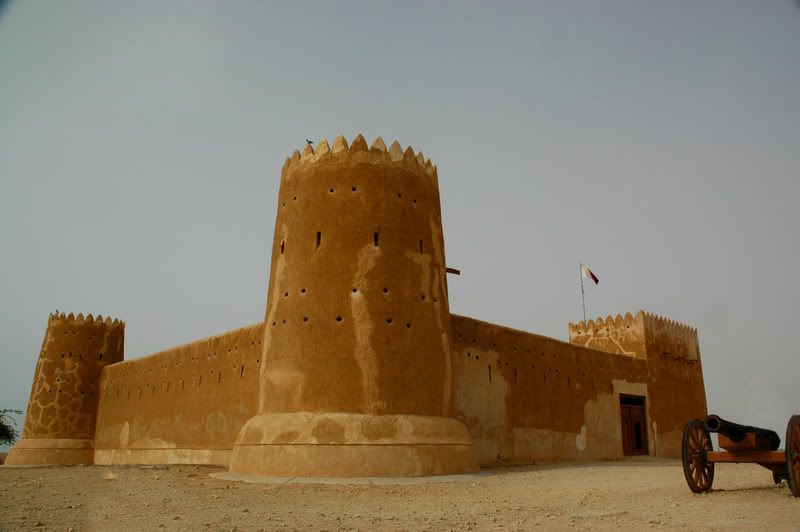
By far the majority of the population of Qatar is concentrated in Doha, the capital. Originally a scantily inhabited fishing village (the capital of the area being Zubara, in the north-west until the eighteenth century), Doha rose to relative eminence in the nineteenth century and became the chief town and residence of the Al-Thani family, later to become the rulers of Qatar. The population explosion that has taken place in Doha, however, is entirely a late twentieth-century phenomenon, due to Qatar's oil wealth. It is estimated that 80% of the population of Qatar (in excess of 670,000) live in Doha. The town is constantly expanding in all directions (except eastward, of course) and is characterised by what seems to be a never ending process of construction.
The focus of the semi-circular shaped city, hugging the contours of the broad, artificially extended bay is undoubtedly the Corniche, a 7 km coastal path, along which many of the key buildings are located, including the Emiri Diwan (royal palace), several ministries and three of the main hotels.
As the capital city, Doha is, as one would expect, the location of the country's government, airport, seaport, main communications centres, hotels and recreational facilities, sports facilities and just about everything else except the oil and gas and related industries.
There are many impressive new buildings in Doha, and occasional examples of interesting architecture are to be found. Sadly, few old buildings remain, but careful searching of the down town souk area will reveal some examples of pre-oil indigenous architecture, particularly featuring wind-towers, which were used as a way of exploiting breezes to keep structures cool.
Although the first time visitor may find Doha a confusing place to get around in, it is actually quite well planned, with arterial roads forming concentric arcs parallel to the bay. There is no designated town centre as such, and key locations are to be found scattered all over.
Considerable effort has been made in planting trees and shrubs along the roadsides and on central reservations, and this, coupled with the parks dotted around the town give a pleasantly green effect.
Although hardly a booming metropolis in the Western sense of the word, Doha has a definite city feel about it, with its ever increasing traffic, population and amenities.